Thursday, May 8, 2014

O mito de Sísifo é a metáfora que abarca a problemática

Um pensador que desconfia até da própria razão:

O homem de Camus já não é o encantado de Tomas de Aquino que cria uma moral a partir da certeza do divino. Muito pelo contrário, Darwin já tinha desmistificado o mito da Criação e Nietchze martelado qualquer sobra de Deus na Ciência. Ele não traz ilusões porém incentiva a coragem humana. Estabelece a crença na existência sem os paradigmas religiosos.


"É preciso contentar-se em descobrir, mas evitar explicar. Em arte só há uma coisa válida: a que não se pode explicar."

O homem absurdo esta dividido em três sujeitos:
1, Don Juan,
2. Ator e
3. Conquistador.

Todos estes sujeitos estão a merce da derrota final, mas agem para se autoafirmarem.
No entanto, todos eles, homem absurdo ou não estão condicionados a tarefa da repetição.
O mito de Sísifo é a metáfora que abarca a problemática.

Vantagem de não se enganar:
"O homem absurdo, que pertence a tradição filosófica do bom pensar não se ilude e tem o fim como certo. Portanto ele se diferencia pois é consciente, logo absurdo."

1.Don Juan - Seduzir e e(x)SgoStar:
É ele quem extrai a melhor conclusão desse fato de que, um dia, tudo tem de morrer.

2.Interpretar e perecer nos diversos papéis:
Um ator tem sucesso ou não o tem. Um escritor mantém uma esperança mesmo se é desconhecido.

3.Conquistar ou Contemplar
Se escolho a ação, não pense que a contemplação me seja como uma terra desconhecida.

Segunda análise:

Será que a realização da plenitude e absurdo da vida exigem suicídio? Será que a realização do absurdo exige o suicídio? Camus responde: "Não. Exige revolta".

Grande parte da nossa vida é construída sobre a esperança do amanhã, do amanhã que nos aproxima da morte, e é o último inimigo; pessoas vivem como se elas não tivessem a certeza da morte.

O absurdo surge quando os humanos precisam entender a satisfação para irracionalidade do mundo, quando "o meu apetite para o absoluto e da unidade" complementa "a impossibilidade de reduzir o mundo a um princípio racional e razoável".

O absurdo nunca pode ser aceito: ele exige constante confronto e revolta.
A constatação do absurdo permite gozar de uma liberdade no que se refere às regras comuns.
A revolta, no que tange à constatação de que a vida é absurda, sem sentido; a liberdade, haja vista a nossa condição humana (estamos sós e escolhemos) e; a paixão, já que não se vive a vida de outro modo.

O Don Juan:
Não há um nobre amor, mas o que reconhece - tanto os efemêros quanto os duradouros

O Ator:
Retratar a vida efêmera da fama efémera.

O Conquistador
Ele escolhe a ação sobre a contemplação, consciente do fato de que nada pode durar e não é vitória final.

"Se o mundo fosse claro, a arte não existiria."

Analisa o trabalho de Fiódor Dostoiévski a partir da posição absurda, e os dois primeiros, a explorar o tema do suicídio filosófico. Especialmente Demônios e Os Irmãos Karamazov.

Sísifo, que desafiou os deuses e derrotou a Morte e é condenado a uma tarefa sem sentido, como o herói absurdo. Não obstante reconheça a falta de sentido, Sísifo continua executando sua tarefa diária.
O operário de hoje trabalha todos os dias em sua vida, faz as mesmas tarefas. Esse destino não é menos absurdo, mas é trágico quando apenas em raros momentos ele se torna consciente


Ta dominado. tá TUDO doutrinado

Monday, May 5, 2014

time discipline

The concept of "time discipline" as a field of special attention in sociology and anthropology was pioneered by E. P. Thompsonin Time, Work-Discipline, and Industrial Capitalism, published in 1967. Coming from a Marxist viewpoint, Thompson argued that observance of clock-time is a consequence of the European industrial revolution, and that neither industrial capitalism nor the creation of the modern state would have been possible without the imposition of synchronic forms of time and work discipline. The new clock time imposed by government and capitalist interests replaced earlier, collective perceptions of time that Thompson believed flowed from the collective wisdom of human societies. While in fact it appears likely that earlier views of time were imposed instead by religious and other social authorities prior to the industrial revolution, Thompson's work identified time discipline as an important concept for study within the social sciences

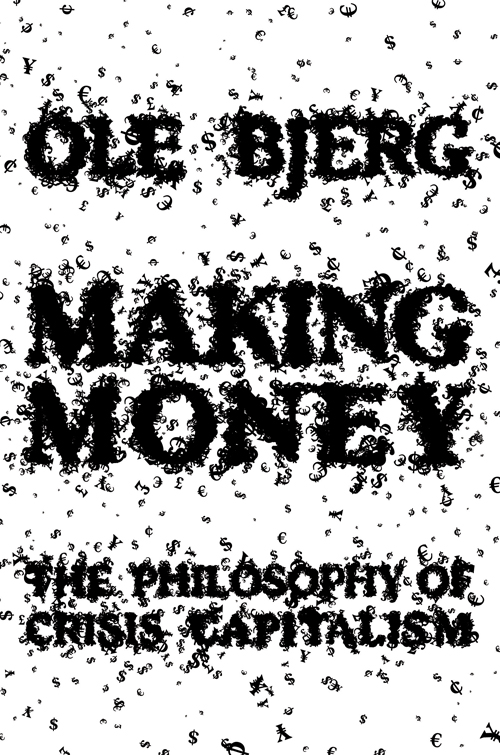
Making Money: The Philosophy of Crisis Capitalism

“Explosive ... an absolutely indispensable guide through the labyrinth of economics.” – Slavoj Žižek
What is money? Where does it come from? Who makes it? And how can we understand the current state of our economy as a crisis of money itself? In Making Money, Ole Bjerg turns these questions into a matter of philosophical rather than economic analysis. Applying the thinking of Slavoj Žižek and other scholars to mainstream economic literature, Bjerg provides a radical new way of looking at the mysterious stuff we use to buy things. It is a theory unfolded in reflections on the nature of monetary phenomena such as financial markets, banks, debt, credit, derivatives, gold, risk, value, price, interests, and arbitrage. The analysis of money is put into an historical context, suggesting that the current financial turbulence and debt crisis are evidence that we live in the age of post-credit capitalism. By bridging the fields of economics and contemporary philosophy, Bjerg's work engages in a compelling form of intellectual arbitrage.

Making Money: The Philosophy of Crisis Capitalism

ByOle Bjerg
money money philosophy of crisis capitalism
What is money? Where does it come from? Who makes it? And how can we understand the current state of our economy as a crisis of money itself?
In Making Money, Ole Bjerg turns these questions into a matter of philosophical rather than economic analysis. Applying the thinking of Slavoj Žižek and other scholars to mainstream economic literature, Bjerg provides a radical new way of looking at the mysterious stuff we use to buy things. It is a theory unfolded in reflections on the nature of monetary phenomena such as financial markets, banks, debt, credit, derivatives, gold, risk, value, price, interests, and arbitrage. The analysis of money is put into an historical context, suggesting that the current financial turbulence and debt crisis are evidence that we live in the age of post-credit capitalism. By bridging the fields of economics and contemporary philosophy, Bjerg’s work engages in a compelling form of intellectual arbitrage.
Buy it here.

Mapa das Exportações e Importações Mundiais

exports
imports

Saturday, May 3, 2014

Deleuze byrne

5 WAYS TO UNDERSTAND DELEUZE THROUGH THE WORK OF DAVID BYRNE AND THE TALKING HEADS Freudian psychoanalysis sees schizophrenia as a condition in which the libidinal energy is detached from objects, causing the subject to lose his grip on reality, and resulting in incoherent speech, confused action and anxiety. For Deleuze, on the other hand, the hallucinations of the schizophrenic are not a poor image of reality, but are in fact the creative productions of a new reality, in which desire is not repressed by the standard social structures.
<blockquote class="twitter-tweet" lang="en"><p>a bananizacao do discurso anti-racismo <a href="http://t.co/OPqpelIyJC">pic.twitter.com/OPqpelIyJC</a></p>&mdash; larry david jr (@JrLdv) <a href="https://twitter.com/JrLdv/statuses/462197929441521664">May 2, 2014</a></blockquote>